
Pietà
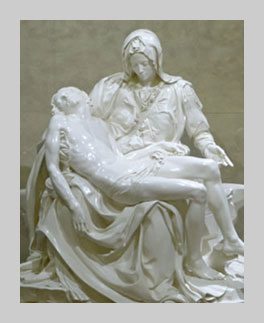
At the age of twenty-three, Michelangelo was commissioned by the French Cardinal Jean de Bilheres to create the Pietá as his tomb monument. He traveled to the marble quarries at Carrara in central Italy to select the block from which to make this large work. The choice of the stone was important because he demanded a perfect integrity in the marble as well as the whitest color and envisioned the statue as already existing within the marble, needing only to be “set free” from it. It was sculpted from 1498-1499 and instantly established Michelangelo as the greatest sculptor of his time.
Georgio Vasari, the great art historian wrote: “It would be impossible for any craftsman or sculptor, no matter how brilliant, ever to surpass the grace or design of this work, or try to cut and polish the marble with the skill that Michelangelo displayed. It is certainly a miracle that a formless block of stone could ever have reduced to perfection that nature is scarcely able to create in the flesh.”
Of all his sculptures, the Pietá was the only one Michelangelo ever signed – in the Pietá, all of Michelangelo’s attention was focused on evoking the ideal of spiritual beauty so important in the time of the Italian Renaissance. It is a testament to his abiding love of God, the source of his inspiration that he was able to capture the compassion and serenity in Mary’s face with so much grace that half a millennium later the vision of it continues to inspire us. One of the greatest sculptures ever created, it stands as an icon for the Christian faith, bringing inspiration to the millions who visit St. Peter’s Basilica every year.
Five hundred years ago, Michelangelo unveiled what would come to be regarded as one of the world’s great masterpieces of inspired art and perhaps the most beautiful sculpture ever created. Now, under exclusive license from the Vatican Observatory Foundation, this masterpiece has been recreated in cast marble and is licensed by the Vatican Observatory Foundation (VOF).